On this page
Daemon Compatibility
Pathvector is one binary with one backend setting — backend: in
pathvector.yml selects which routing daemon's native config is rendered and
which control channel is driven. The peer model, templates, PeeringDB, IRR,
communities, policy, and the optimizer are shared by every backend.
Every backend is verified against released daemon versions by automated test
matrices that run on every change to dev/main.
Tested versions
| Backend | Daemon | Verified versions | Result |
|---|---|---|---|
bird (default) |
BIRD | v2.0.7 – v3.4.0 (15 releases) | all pass — one known XFAIL |
frr |
FRR | frr-9.1.3 – frr-10.7.1 (7 releases) | core pass — FRR ≤ 10.0 needs rpki-enable: false |
cairn |
Cairn | 0.1.1 | e2e pass (private beta) |
Regenerate this table from the matrix version files with make compat
(tests/compat-report.sh).
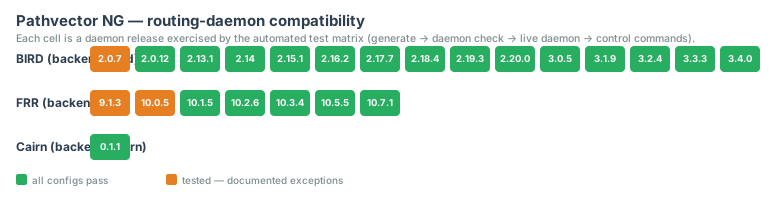
Regenerate the chart with tests/gen-compat-heatmap.py.
<details> <summary>Every version exercised</summary>
BIRD — v2.0.7 v2.0.12 v2.13.1 v2.14 v2.15.1 v2.16.2 v2.17.7
v2.18.4 v2.19.3 v2.20.0 v3.0.5 v3.1.9 v3.2.4 v3.3.3 v3.4.0
FRR — frr-9.1.3 frr-10.0.5 frr-10.1.5 frr-10.2.6 frr-10.3.4
frr-10.5.5 frr-10.7.1
Cairn — 0.1.1
</details>
Checking your daemon
Run pathvector compat on the router to query the installed daemon's version
and compare it against the tested range:
$ pathvector compat
Backend:      bird
Daemon:       BIRD
Version:      3.4.0
Tested range: v2.0.7 – v3.4.0
Status:       supported
Status is supported inside the tested range, newer-than-tested above it
(probably fine, but not CI-covered — report issues), older-than-tested below
the minimum, or unreachable/unknown when the daemon can't be queried. Run
it on the router itself — generate is often run on a separate config host
where the daemon isn't installed.
What each matrix entry checks
For every version in versions.txt the matrix:
- Generates Pathvector's config for that backend.
- Validates it with the daemon's own checker —
bird -p,vtysh -C/vtysh -b, orcairnd --check. - Runs a live daemon on the generated config.
- Drives the control channel —
status,restart,diff, and the metrics endpoint.
On top of the per-version matrices, tests/e2e runs a full dual-stack BGP
lab (IPv4 + IPv6 sessions, route propagation both directions, IRR filtering,
optimizer probing, all CLI commands) against BIRD, and tests/cairn-e2e runs
the equivalent lab against Cairn.
Support policy
- BIRD — minimum
v2.0.7(supportedMininpkg/bird/bird.go), enforced at runtime. No maximum: BIRD 3.x is fully supported. - FRR — the generated config targets ≥ 10.1. FRR ≤ 10.0 works with
rpki-enable: false(therpki cache tcpkeywords were added in 10.1). FRR 7.x/8.x predate libyang 2 and can't build on the modern toolchain. - Cairn — experimental. Cairn is early-release/private-beta; its
.debisn't publicly distributed, sotests/cairn-e2eneeds a local package.
Known limitations
These are documented, version-specific gaps — not silent failures:
| Version | Limitation |
|---|---|
| BIRD v2.0.7 | generate-complex fails: transit-lock + AS-path mask needs ≥ 2.0.8 (XFAIL) |
| FRR ≤ 10.0 | rpki cache tcp unsupported — set rpki-enable: false |
| FRR ≤ 8.x | Can't build on modern toolchain — unsupported |
| Cairn | Early-release; unsupported peer features are warned, not dropped |
Adding a version
Append the release tag to the matching file — CI picks it up automatically:
tests/bird-matrix/versions.txt— BIRD git tags (vX.Y.Z)tests/frr-matrix/versions.txt— FRR git tags (frr-X.Y.Z), with an optional second field for a source-built libyang ref on older releasestests/cairn-e2e/— Cairn releases (requires the private.deb)
If a new version exposes an incompatibility, add it to the matching
xfail.txt with a reason rather than silently skipping it — an unexpected
pass (XPASS) fails the build so stale entries get cleaned up.